
AI Voice Agent for Lead Qualification: Setup Guide Fish Audio
Design lead-qualification calls with scoring, consent, CRM handoff, latency checks and clear Fish Audio speech-layer boundaries for sales teams.
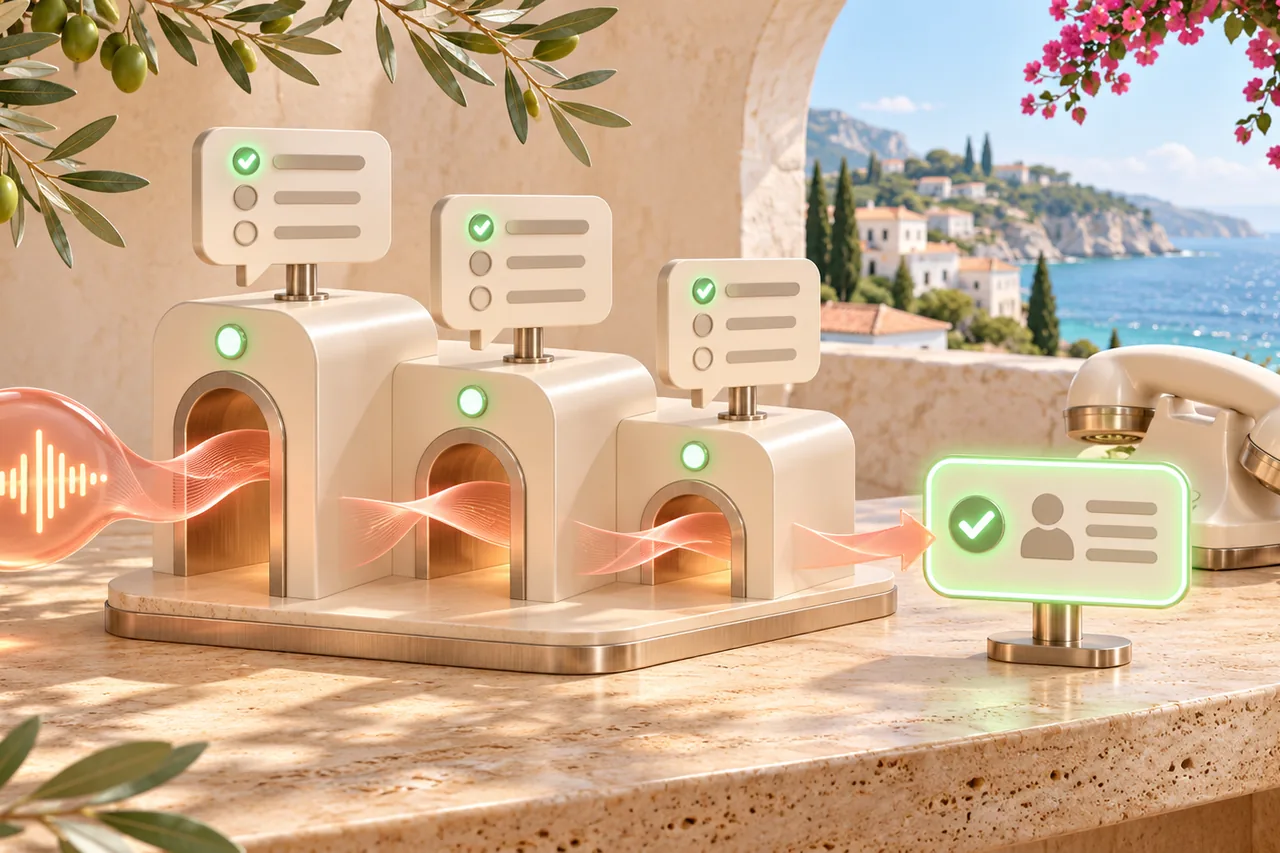
An AI voice agent for lead qualification is a bounded calling workflow: confirm consent, ask a consistent set of discovery questions, score the answers against explicit rules and hand a structured record to sales. Fish Audio supplies the speech layer — speech to text for the prospect, streaming text to speech for the agent, a reusable voice identity and API access. Your application owns the script, scoring model, CRM, dialer and compliance policy.
The value is consistency, not persuasion. A qualification agent should collect the same facts on every call, record them the same way and stop when the conversation moves outside its authority.
What does a qualification call actually contain?
A reliable call has six stages:
- Disclosure and consent. Say who is calling, why, whether the call is recorded and how to opt out.
- Identity check. Confirm the person's name, company and role without collecting unnecessary identifiers.
- Problem discovery. Ask what prompted the inquiry and what the prospect is trying to change.
- Fit questions. Capture timeline, decision process, current solution and an indicative budget range.
- Scoring and routing. Apply fixed rules, store the evidence and decide: book a meeting, route to a rep or close the loop politely.
- Handoff. Send the transcript, answers, score, consent status and source to the CRM.
The AI voice agent architecture guide explains how transcription, retrieval, dialogue and speech streaming fit together. For the support-side loop, see AI voice agents for customer support.
Which qualification signals should the agent capture?
Capture signals that change the next action, not everything a form could ask. A practical set is:
- Problem and urgency: what is broken, and what happens if it stays broken.
- Timeline: a specific window, such as this quarter, next quarter or no active project.
- Authority: who signs off, who evaluates and who else is involved.
- Current state: the tool, process or vendor in use today.
- Indicative budget: a range, clearly labeled as an estimate rather than a quote.
- Consent: recording permission and the channel the prospect prefers for follow-up.
Do not ask for payment details, passwords, government IDs, health information or other sensitive categories. A qualification call does not need them, and collecting them expands your compliance surface.
How should scoring and routing work?
Use deterministic rules first. For example: a named problem, a timeline inside 90 days, identified decision authority and a budget range above your floor produce a qualified score. Missing two or more of those signals produces nurture, not an immediate handoff.
Keep a confidence field beside the score. If speech recognition fails on a company name or the prospect gives an ambiguous answer, the agent should ask a clarifying question rather than invent a value. Store the exact answer that produced each score so a salesperson can audit it.
The routing decision should be one of a small set:
| Outcome | Next action |
|---|---|
| Qualified | Book a meeting or transfer to sales |
| Nurture | Send approved follow-up and set a reminder |
| Not a fit | Close politely and record the reason |
| Needs a human | Transfer with transcript and open questions |
Never let the agent promise pricing, discounts or implementation dates that are outside the approved script.
What should a qualification call sound like?
A short, realistic flow:
Agent: Hi, this is Ava from Northwind. I'm following up on your request about the analytics migration. This call is recorded for quality; is that okay?
Prospect: Yes, that's fine.
Agent: Thanks. What prompted you to look at a migration now?
Prospect: Our current warehouse is too slow for the finance team.
Agent: Understood. Is the team evaluating a replacement this quarter, or is this earlier research?
Prospect: We want a decision before the end of next quarter.
Agent: Who else would review the technical fit?
Prospect: Our data lead, Priya.
Agent: That's helpful. I'll note the timeline and ask a specialist to follow up with Priya. Would tomorrow morning or afternoon work for a 20-minute call?
The agent keeps each turn short, confirms the answer before moving on and stops asking once the routing decision is clear.
Where does Fish Audio fit in the stack?
Fish Audio provides four speech capabilities:
- Speech to text for the prospect's audio, including speaker turns.
- Streaming text to speech so the first words arrive before the full answer is generated.
- A consistent voice identity, including an authorized cloned brand voice.
- API access and concurrency for simultaneous calls, available with the Studio pack.
Fish Audio does not provide telephony, dialing, CRM synchronization, lead scoring, calendar booking or a dialogue manager. Those are your application's responsibility or the responsibility of a platform you integrate.
The telephony text to speech API guide covers audio formats, SIP and streaming boundaries. The TTS API for voice agents guide compares providers by latency, voice identity and fallback.
How should consent and recording be handled?
Disclose the caller's identity, the purpose of the call and whether the call is recorded before substantive discovery. Follow the consent rules that apply in the prospect's jurisdiction and your own; this guide is not legal advice.
Store the consent record with the call: timestamp, exact disclosure text, response and the channel used. Make opt-out easy and honor it across future calls. If the prospect declines recording, the safe default is a human follow-up rather than silently continuing.
For voice cloning, the speaker must authorize the intended use. The voice cloning consent guide explains the permission record and revocation process.
What latency and quality targets matter?
Qualification calls are less latency-sensitive than support calls, but long silence still breaks the conversation. Track p50 and p95 time to first audio, not only the average. A useful pilot target is a p95 first-audio latency low enough that the prospect does not ask whether the line is still connected.
Also measure barge-in cancellation: when the prospect starts speaking, the agent must stop its current answer and listen. The real-time text to speech guide covers streaming and interruption budgets.
Choose a calm, mid-paced voice with clear consonants. Test it on company names, product names, numbers and acronyms, because those are the phrases that produce the most repair turns.
What are the common failure modes?
| Failure | Safe fallback |
|---|---|
| Speech recognition misses a name or number | Ask the prospect to spell or confirm it; never guess |
| CRM or enrichment API times out | Finish the call, mark the record incomplete and queue a retry |
| Prospect gives an ambiguous answer | Ask one clarifying question, then record "unclear" |
| Prospect asks for pricing or an exception | Explain that a specialist will follow up; do not improvise |
| Voicemail or IVR answers | Leave the approved message and log the attempt |
| Confidence falls below policy | Transfer or end courteously with a human follow-up |
Every fallback should be visible in the transcript and the CRM record. Silent failure is worse than an honest handoff.
How much does qualification speech cost?
Natural speech is roughly 150 words per minute, close to 900 characters. One Fish Audio credit covers about 1,000 characters, so agent speech starts near one credit per minute before retries, pauses or longer answers.
| Pack | Price | Credits | Approximate agent speech |
|---|---|---|---|
| Starter | $9 | 1,000 | About 16 hours |
| Creator | $29 | 4,000 | About 66 hours, plus commercial rights |
| Studio | $99 | 15,000 | About 250 hours, plus API access |
Transcription, telephony, dialing, CRM seats and human follow-up are separate costs. The TTS API pricing guide converts character volume into a full budget.
How should you measure success?
Track business outcomes and speech quality separately:
| Metric | What it tells you |
|---|---|
| Qualified-meeting rate | Whether the scoring rules match sales reality |
| Wrong-qualification rate | Whether the agent is over-accepting leads |
| Human transfer rate | Whether the boundary policy is working |
| p95 time to first audio | Whether the conversation feels responsive |
| Barge-in cancellation rate | Whether the agent yields when interrupted |
| Consent capture rate | Whether disclosure is complete |
| CRM field completeness | Whether handoff is useful to sales |
Review a sample of transcripts every week. Aggregate dashboards hide the pattern that matters most: the specific question the agent asks badly.
Key takeaways
- Fish Audio supplies speech; your application owns questions, scoring, CRM and compliance.
- Ask only the questions that change the next action.
- Keep scoring deterministic and auditable.
- Disclose recording and capture consent before discovery.
- Design a human transfer for ambiguity, exceptions and requests for a person.
- Budget roughly one credit per minute of generated speech, plus telephony and transcription.
Frequently asked questions
What does an AI voice agent for lead qualification do?
It calls or answers inbound prospects, confirms identity and consent, asks a fixed set of qualification questions, scores the answers against rules and routes the result to a CRM or sales queue. Fish Audio supplies the speech layer; your application owns the questions, scoring and CRM.
Can Fish Audio score or route leads by itself?
No. Fish Audio provides speech to text, text to speech, voice cloning and API access. Scoring logic, CRM fields, routing rules, dialing and compliance policy remain in your application or sales platform.
Which questions should the agent ask first?
Start with consent and recording notice, then the problem, timeline, decision authority and budget range. Avoid asking for card numbers, government identifiers, health details or other sensitive data that a qualification call does not need.
How much does one minute of qualification speech cost?
At roughly 150 words per minute, one minute of agent speech is about 900 characters, or one Fish Audio credit. Prospecting silence, voicemail detection, retries, transcription and telephony are separate costs.
When should the agent transfer a lead to a salesperson?
Transfer when the prospect asks for a person, the score crosses your qualified threshold, a commitment or exception is requested, or confidence falls below policy. Pass the transcript, score, consent record and answers into the CRM.
Related guides
- AI voice agent architecture - the full speech loop and where each component belongs.
- AI voice agent for appointment booking - turning a qualified lead into a booked meeting.
- AI voice agent for ecommerce - order and returns conversations with identity checks.
- TTS API for voice agents - compare latency, voice identity and fallback.
- Telephony text to speech API - PCM, SIP and phone-platform boundaries.