
AI Voice Agent for Ecommerce: Support Playbook Fish Audio
Build an ecommerce voice agent for order status, returns and address changes using authentication, escalation, privacy and secure speech workflows.
An AI voice agent for ecommerce is a narrow support workflow: identify the caller, look up the order, explain the state and either complete a safe action or escalate. Fish Audio supplies transcription, streaming text to speech, a consistent brand voice and API access. Your commerce platform owns order data, authentication, returns policy and payment security. The agent must never capture card details or promise a refund or delivery date that your systems have not confirmed.
The best first use cases are high-volume and low-risk: "where is my order," delivery exceptions, return eligibility and address changes before fulfillment. Payment disputes, fraud review and policy exceptions belong to people.
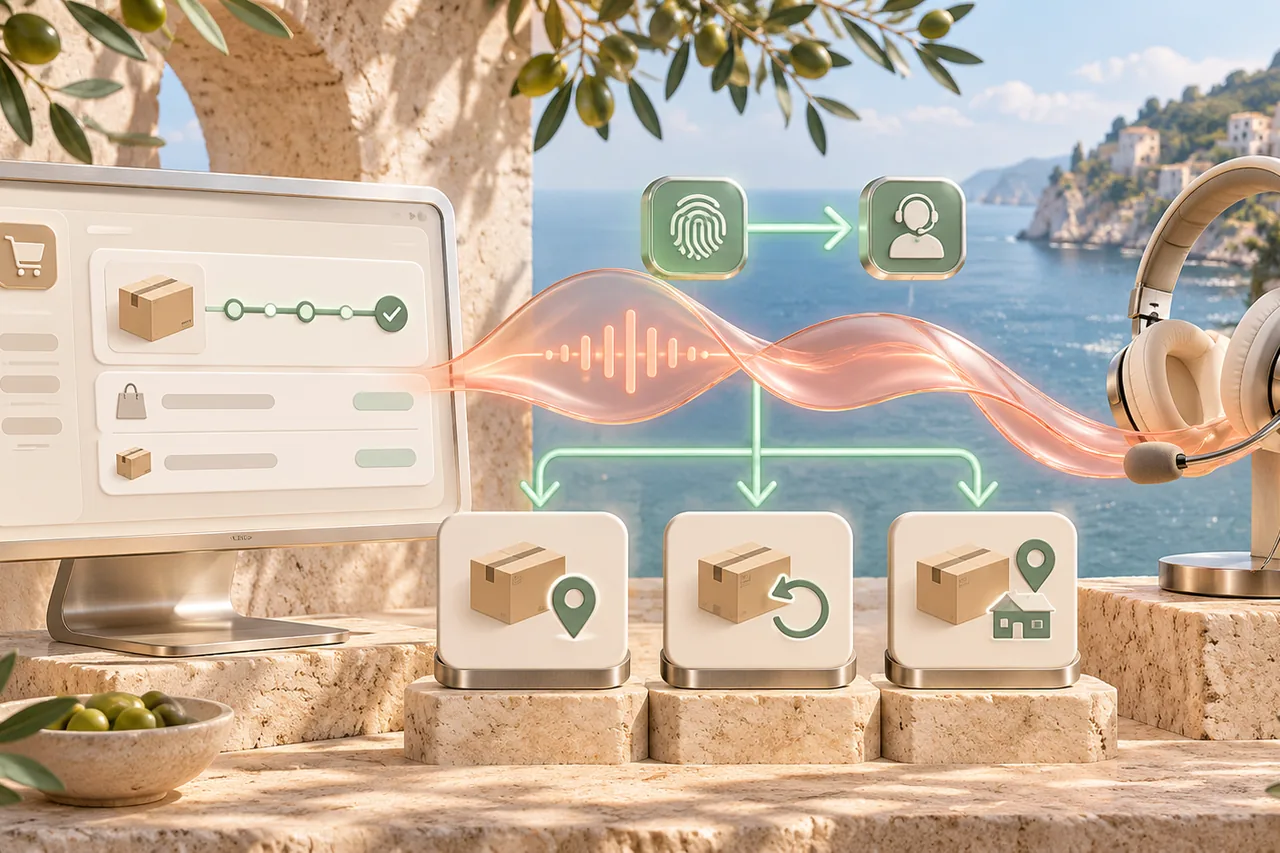
Which requests should the agent own?
A practical split:
| Request | Agent role | Boundary |
|---|---|---|
| Order status | Read from the order API and explain | No invented delivery dates |
| Delivery exception | Explain the carrier state and next step | No promise the carrier cannot keep |
| Return eligibility | Read policy and start an approved return | Exceptions go to a human |
| Address change | Verify identity and update before fulfillment | No change after dispatch without carrier process |
| Product question | Answer from approved catalogue data | No medical, safety or legal claims |
| Refund status | Read the refund record | No new refund decision |
| Payment details | Never collect card data | Use a secure link or human flow |
For the broader support loop, see AI voice agents for customer support. For calls that qualify a buyer before purchase, see AI voice agents for lead qualification.
How should identity verification work?
Match the check to the risk. Reading an order status may need only an order number and the email or postal code on the order. Changing a delivery address, starting a high-value return or discussing account details needs a stronger factor, such as a one-time code sent to the email or phone on file.
The agent should say what it is doing and why: "I'll send a six-digit code to the email on the order." It should not ask the caller to read a password, full card number or government ID.
If verification fails, do not reveal whether the order number exists. Offer the standard recovery path and transfer to a human when the caller needs an exception. Log the failed attempt without storing unnecessary personal data.
What should an order-status call sound like?
Agent: Thanks for calling Willow Supply. Is this about an order, a return or a product question?
Caller: My order hasn't arrived.
Agent: I can check that. What's the order number?
Caller: WS-48219.
Agent: And the email used for the order?
Caller: dana@example.com.
Agent: The parcel left the warehouse on November 2 and the carrier's last scan was yesterday in Newark. The estimated delivery is November 6, but that is an estimate, not a guarantee. Would you like me to send the tracking link?
Caller: Yes, and can I change the address?
Agent: The order has already shipped, so I can't change the address here. I can open a carrier interception request or connect you with a support specialist. Which would you prefer?
The agent reports what the system knows, labels estimates as estimates and offers a real next step.
How should returns and refunds be handled?
Read the return policy from an approved source and check the specific order against it: purchase date, category, condition, final-sale flag and whether the item was personalized. Do not infer eligibility from a general policy if the order has exceptions.
For an eligible return, create the return record, give the return label and explain the inspection and refund timeline. For an ineligible or disputed return, transfer to a human rather than negotiating.
Refund status is a read, not a decision. If the system shows a refund issued, explain the method and expected posting window. If no refund exists, do not promise one.
How should address changes and fraud be handled?
Allow address changes only before fulfillment and only after stronger verification. Check whether the order is already picked, packed or handed to the carrier; a "processing" status is not proof that a change is safe.
Apply your fraud rules before committing the change. A new address immediately after a payment-method change is a review signal, not a routine update. When the risk score is high, transfer to fraud review.
Never read back a full address as a verification method. Confirm the last line or postal code instead, and send the change confirmation to the original contact channel.
Where are the privacy and payment boundaries?
Keep card data out of the voice conversation entirely. Use a hosted payment page, a secure link sent by SMS or email, or your telephony provider's payment capture flow. The voice agent should never hear, repeat or log a card number, security code or bank credential.
Minimize what you store: order number, verification result, transcript, action taken and consent. Do not store full addresses, emails or phone numbers in analytics logs when a reference ID is enough. The voice cloning consent guide covers the separate consent needed for a cloned brand voice.
What are the common failure modes?
| Failure | Safe fallback |
|---|---|
| Order API times out | Take a message or callback; do not guess the status |
| Carrier tracking is stale | Explain the last scan and offer the tracking link |
| Identity verification fails | Offer the standard recovery path; do not reveal order existence |
| Address change arrives after dispatch | Explain the carrier process and transfer if needed |
| Return policy is ambiguous | Transfer to a human; do not promise eligibility |
| Caller disputes a refund | Transfer with the order and refund record |
| Audio quality is poor | Slow down, confirm key digits, or offer a callback |
Log the tool response beside the transcript so support can see what the agent actually saw.
Which metrics should you track?
| Metric | What it tells you |
|---|---|
| Containment rate | Share of calls resolved without a human |
| Repeat contact rate | Whether the first answer actually resolved the request |
| Verification failure rate | Whether the identity check is too strict or too weak |
| Return completion rate | Whether the return flow works end to end |
| Wrong-order access rate | A safety incident, not just a metric |
| p95 time to first audio | Whether the agent feels responsive |
| Transfer quality | Whether the human receives usable context |
Containment without resolution is not success. Pair it with repeat contact, complaint rate and accuracy audits.
How much does ecommerce support speech cost?
Natural speech is roughly 150 words per minute, close to 900 characters. One Fish Audio credit covers about 1,000 characters, so agent speech starts near one credit per minute before retries or longer explanations.
| Pack | Price | Credits | Approximate agent speech |
|---|---|---|---|
| Starter | $9 | 1,000 | About 16 hours |
| Creator | $29 | 4,000 | About 66 hours, plus commercial rights |
| Studio | $99 | 15,000 | About 250 hours, plus API access |
Telephony, transcription, order and returns platforms, carrier lookups and human support remain separate. The TTS API pricing guide converts characters into a working budget.
Key takeaways
- Start with order status, delivery exceptions, returns and pre-fulfillment address changes.
- Keep card data out of the voice conversation entirely.
- Match verification strength to the risk of the action.
- Never invent an order state, refund or delivery date.
- Log the tool response beside the transcript.
- Measure repeat contact, not only containment.
Frequently asked questions
What should an ecommerce voice agent handle?
Start with order status, delivery exceptions, return eligibility, address changes before fulfillment and product or policy questions. Keep payment authorization, fraud decisions and exceptions with a human or a secure payment flow.
Can the agent take card payments over the phone?
Do not collect card numbers in the conversation. Use a secure payment link, a hosted checkout or your telephony provider payment flow, and keep the agent outside the cardholder-data boundary.
How should the agent verify a caller?
Use at least two signals appropriate to the risk, such as order number plus email or postal code, and add a one-time code for changes with financial or delivery impact. Weak signals alone should not authorize an address change.
What happens when the order system is unavailable?
Do not guess an order state. Tell the caller the lookup is unavailable, take a message or offer a callback, and log the request with the order number and consent to contact.
How much does ecommerce support speech cost?
At roughly 150 words per minute, one minute of agent speech is about one Fish Audio credit. Order APIs, telephony, carrier lookups, returns platforms and human agents are separate costs.
Related guides
- AI voice agent for customer support - the full support loop and escalation policy.
- AI voice agent for restaurant orders - menu, order and allergy boundaries.
- AI voice agent for lead qualification - pre-purchase qualification calls.
- Voice agent TTS fallback - what to do when a provider or tool fails.
- Text to speech API pricing - character budgets and cross-provider costs.